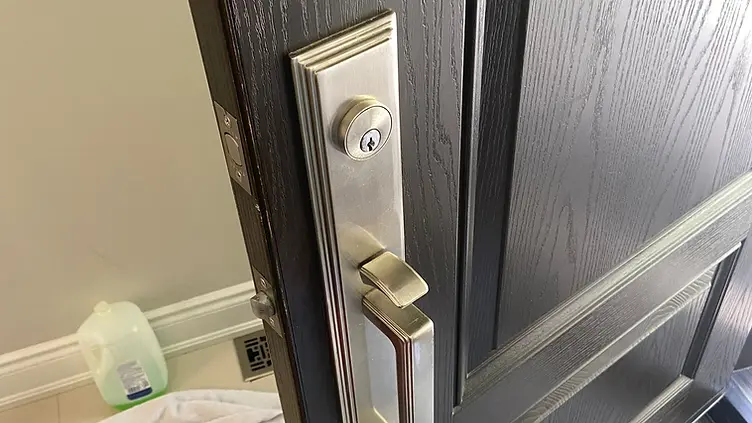
A door that rubs the frame, drags on the floor or only latches if you lean on it is one of the most common calls we get in Etobicoke. It's rarely the lock. Most of the time the door has moved a few millimetres, and the fix is simpler than people expect.
Why doors stick in Etobicoke homes
Etobicoke has a bit of everything: post-war bungalows in Alderwood and Islington, older houses near the lake in Mimico and New Toronto, split-levels up in Rexdale, and condo towers at Humber Bay Shores. The causes are mostly the same everywhere.
Humidity. Wood doors swell in a humid summer and shrink once the furnace dries the house out. A door that rubs in July may be fine in January, or the other way around. Homes near the lake feel this more.
Loose hinges. The top hinge carries most of the door's weight. When its screws loosen, the door drops at the latch side and starts rubbing the frame near the top corner, or dragging at the bottom.
A house that's settled. Older houses move over decades. Frames go slightly out of square, and the latch no longer lines up with the strike plate.
Paint. Layers of paint on the door edge and frame add up. Eventually there's no gap left.
What you can check yourself
- Look at the gap around the closed door. If it's tight at the top on the latch side and wide at the bottom, the door has sagged.
- Open the door and lift the handle. If the door moves up and down at the hinges, the screws are loose.
- Watch the latch as the door closes slowly. Scratch marks above or below the strike plate show which way it's missing.
- Tighten the hinge screws with a screwdriver. If one just spins, the hole is stripped. Don't keep cranking it.
How it gets fixed
Most sticking doors are sorted with one or more of these:
- Longer screws in the top hinge, long enough to bite into the framing behind the door jamb. This pulls the door back up and is often the whole fix.
- Shimming or adjusting a hinge to change the angle the door hangs at.
- Moving or filing the strike plate so the latch catches cleanly.
- Planing the edge that rubs. Only after the hinges are right, and the bare wood gets sealed afterwards so it doesn't soak up moisture and swell again.
- New weatherstripping on exterior doors, if the old stuff is crushed or torn and the door is fighting it to close.
Planing a door that only sticks because of a loose hinge is a common mistake. Once the hinge is fixed, you're left with a gap.
Condo doors are different
The entry door to a condo unit is usually a fire-rated door, and it isn't yours to plane or modify. If it's sticking or not latching, tell building management first. We can adjust hardware where it's allowed, but trimming the door itself is off the table.
When the lock is the problem
If the door closes fine but the key is stiff, the latch won't retract, or the handle is loose, that's hardware. Repairs and replacements are part of our door and lock repair service.
Getting it fixed
Sticking doors are usually a short visit, so they're a good one to bundle with other small jobs. See booking a handyman for small repairs for how to put a list together.
Door sticking or not latching? Call or text 416Fix at (365) 360-1416. A photo of the closed door showing the gaps, plus one of the latch side, helps us see what's going on.